Comparative Evaluation of Herbal Sunscreen Extracts Using the Lokapure SPF Equation: A Reassessment of Classical Mansur Spectrophotometric Data Using Syzygium cumini Fruit Extract
DOI:
https://doi.org/10.66220/b4rdph29Keywords:
Syzygium cumini, Jamun, Sun Protection Factor, Lokapure SPF Equation, Natural Sunscreen, UV–Visible Spectrophotometry, Broad-Spectrum Photoprotection, Flavonoids, Photoaging, DNA DamageAbstract
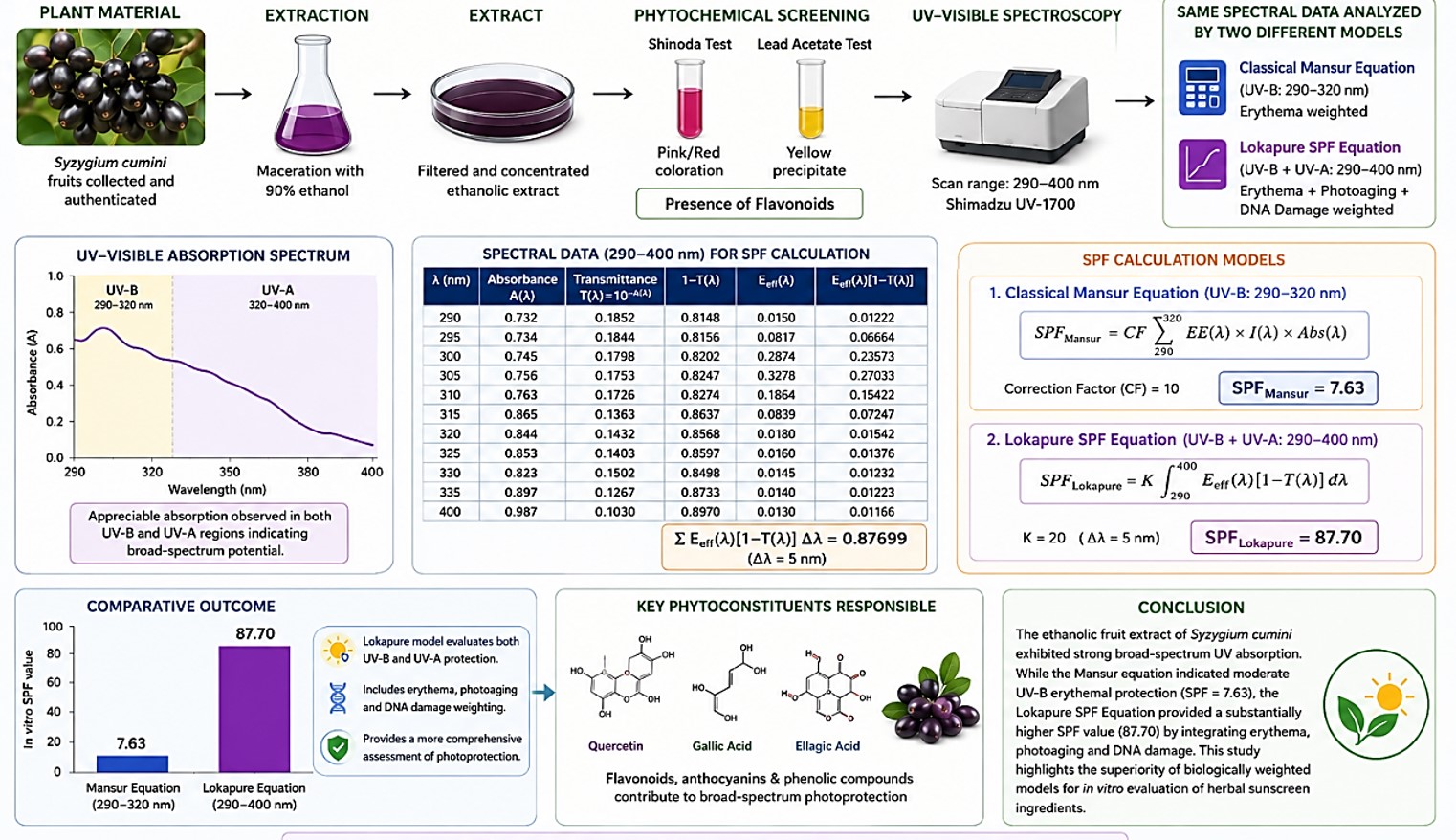
The increasing interest in plant-derived sunscreen agents has created a need for more comprehensive methods to evaluate their photoprotective efficacy. The classical Mansur spectrophotometric equation is widely used for in vitro Sun Protection Factor (SPF) determination but is primarily limited to UV-B-induced erythemal protection. The present study aimed to comparatively evaluate the photoprotective potential of Syzygium cumini fruit extract by reassessing the same UV–Visible spectrophotometric dataset using both the classical Mansur equation and the recently developed Lokapure SPF Equation. Fresh fruits of Syzygium cumini were extracted with 90% ethanol by maceration and subjected to qualitative phytochemical screening for flavonoids. The UV absorption spectrum of the extract was recorded between 290 and 400 nm using a Shimadzu UV-1700 UV–Visible spectrophotometer. The obtained spectral data were analyzed using the Mansur equation based on erythemal weighting factors and the Lokapure SPF Equation incorporating biologically weighted functions for erythema, photoaging, and DNA damage.The ethanolic fruit extract demonstrated appreciable ultraviolet absorption across both the UV-B and UV-A regions. The Mansur equation yielded an in vitro SPF value of 7.63, whereas reassessment of the same spectral dataset using the Lokapure SPF Equation produced an SPF value of 87.70, reflecting a broader biological assessment of photoprotection. The observed activity is attributed to the presence of flavonoids, anthocyanins, gallic acid, ellagic acid, quercetin, and other polyphenolic constituents. However, the present findings are based solely on in vitro spectrophotometric evaluation of a crude plant extract and do not account for formulation characteristics, photostability, skin penetration, or standardized in vivo SPF performance. Therefore, further formulation studies and clinical validation are required to confirm the practical photoprotective efficacy of the extract. The comparative evaluation demonstrates that although the Mansur equation remains suitable for routine UV-B SPF estimation, the Lokapure SPF Equation provides a more comprehensive assessment by integrating erythema, photoaging, and DNA damage. The findings support the potential of Syzygium cumini as a promising natural broad-spectrum sunscreen ingredient and highlight the usefulness of biologically weighted mathematical models for next-generation in vitro sunscreen evaluation.
Downloads
References
1. World Health Organization. Ultraviolet radiation and human health. Geneva: World Health Organization; 2017.
2. Young AR. Acute effects of UV radiation on human eyes and skin. Prog Biophys Mol Biol. 2006;92(1):80-85. doi: 10.1016/j.pbiomolbio.2006.02.005.
3. Rook A, Burns T, Breathnach S, Cox N, Griffiths C, editors. Rook's Textbook of Dermatology. 9th ed. Oxford: Wiley-Blackwell; 2016.
4. Diffey BL. Human exposure to ultraviolet radiation. Semin Dermatol. 1990;9:2-10.
5. International Commission on Illumination. Action spectrum for erythema in human skin. CIE Publication No. 106. Vienna: International Commission on Illumination; 1993.
6. Fantato CM, Tenório JAS, Baby AR. Sunscreen and UV filters: A comprehensive review of formulation, safety, and efficacy. Int J Pharm. 2026;696:126852. Doi: 10.1016/j.ijpharm.2026.126852.
7. International Organization for Standardization. ISO 24444:2019 Cosmetics—Sun protection test methods—In vivo determination of the Sun Protection Factor (SPF). Geneva: International Organization for Standardization; 2019.
8. Mansur JS, Breder MNR, Mansur MCA, Azulay RD. Determination of Sun Protection Factor by spectrophotometry. An Bras Dermatol. 1986;61(3):121-124.
9. Saewan N, Jimtaisong A. Natural products as photoprotection. J Cosmet Dermatol. 2015;14(1):47-63. doi: 10.1111/jocd.12123.
10. Nichols JA, Katiyar SK. Skin photoprotection by natural polyphenols. Arch Dermatol Res. 2010;302(2):71-83. doi: 10.1007/s00403-009-1001-3.
11. Sirswal S, Singh S. Nanotechnology-enhanced herbal sunscreens: A natural approach to UV protection and skin care. Life Drug Deliv. 2026;100362. doi: 10.1016/j.lddd.2026.100362.
12. Kaur M, Chauhan RD, Kannojia P, Singh B. Herbal sunscreens in the era of green cosmeceuticals: Reviewing the role of polyphenols. World J Pharm Res. 2026;15(5):1661-1676. doi: 10.5281/zenodo.18884768.
13. Yadav PR, Galib. A scoping review of methodologies opted for photoprotection of herbal formulations: Evaluation techniques for plant-based sunscreens. Indian J Tradit Knowl. 2026;25(4):309-325. doi: 10.56042/ijtk.v25i4.22916.
14. Baliga MS, Bhat HP, Baliga BRV, Wilson R, Palatty PL. Phytochemistry, traditional uses and pharmacology of Syzygium cumini (L.) Skeels: A review. Food Res Int. 2011;44(7):1776-1789. doi: 10.1016/j.foodres.2011.02.007.
15. Ayyanar M, Subash-Babu P. Syzygium cumini (L.) Skeels: A review of its phytochemical constituents and traditional uses. J Ethnopharmacol. 2012;143(1):1-18. Doi: 10.1016/S2221-1691(12)60050-1.
16. Bhadana R, Rani V. Effect of Syzygium cumini on Oxidative Stress Induced Cardiac Cellular Anomalies. Cardiovasc Hematol Agents Med Chem, 2025;23(1):29-40. doi: 10.2174/0118715257273859231211112731.
17. Lokapure SG. A new Sun Protection Factor equation—Integrating erythemal and photoaging risks across biological and space UV exposure. Res J Top Cosmet Sci. 2026;17(1):11-14. doi: 10.52711/2321-5844.2026.00003.
18. Marcon GZ, Theisen MC, Castro AM, Radke GJ, Fumagalli F. Advances in organic UV filters for sunscreens over the past decade. Photochem Photobiol. Accepted manuscript. Published online 2026. doi: 10.1111/php.70099.
19. Afonso MS, Souza PM, Santos AL, et al. Revolutionizing sun protection: Emerging nanotechnologies shaping the future of sunscreens. ACS Pharmacol Transl Sci. 2026;9(3):545-565. doi: 10.1021/acsptsci.5c00738.
20. Popiół-Adamska J, et al. Natural photoprotection under scrutiny: An in vitro evaluation. Photochem Photobiol Sci. 2026 Jun;25(6):1145-1153. doi: 10.1007/s43630-026-00911-2.
Downloads
Published
Issue
Section
License
Copyright (c) 2026 Pratik Maske, Shobraj Malavi, Umesh Bhupal Kolap (Author)

This work is licensed under a Creative Commons Attribution-NonCommercial 4.0 International License.
In submitting an article to the Journal of PhytoPharmaceutical and Advanced Chemistry (JPPAC) I certify that:
- I am authorized by my co-authors to enter into these arrangements.
- I warrant, on behalf of myself and my co-authors, that:
- the article is original, has not been formally published in any other peer-reviewed journal, is not under consideration by any other journal and does not infringe any existing copyright or any other third party rights;
- I am/we are the sole author(s) of the article and have full authority to enter into this agreement and in granting rights to JPPAC are not in breach of any other obligation;
- the article contains nothing that is unlawful, libellous, or which would, if published, constitute a breach of contract or of confidence or of commitment given to secrecy;
- I/we have taken due care to ensure the integrity of the article. To my/our - and currently accepted scientific - knowledge all statements contained in it purporting to be facts are true and any formula or instruction contained in the article will not, if followed accurately, cause any injury, illness or damage to the user.
- I, and all co-authors, agree that the article, if editorially accepted for publication, shall be licensed under the Creative Commons Attribution-NonCommercial 4.0 International License
- I, and all co-authors, agree that, if the article is editorially accepted for publication in the Journal of PhytoPharmaceutical and Advanced Chemistry (JPPAC) data included in the article shall be made available under the Creative Commons 1.0 Public Domain Dedication waiver, unless otherwise stated. For the avoidance of doubt it is stated that sections 1, 2, and 3 of this license agreement shall apply and prevail.