Hypoglycemic Activity of Lentinus squarrosulus (Mont.) Singer in Streptozotocin Induced Diabetic Rats
DOI:
https://doi.org/10.66220/4zaan445Keywords:
Lentinus squarrosulus, Pleurotus squarrosulus, white shiitake, Mushroom Antidiabetic activity, Hypoglycemic effect, Triglycerides, CholesterolAbstract
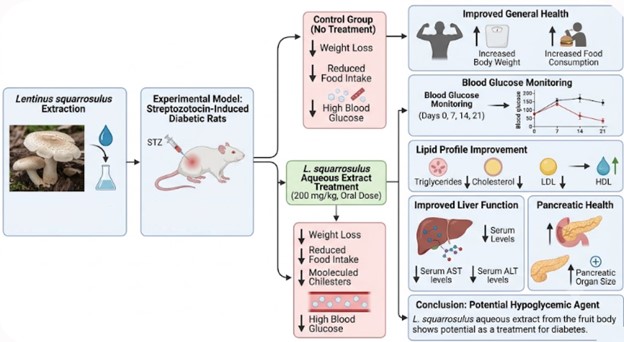
Lentinus suarrosulus (Mont.) Singer also kown as Pleurotus Squarrosulus or white shiitake, is an edible and medicinal mushroom belonging to the poluporaceae family. It is commonly used to treat anemia, fever, cough, and infertility, and it exhibits antioxidant and antidiabetic activity. The hypoglycemic properties of its aqueous extract were tested in diabetic rats induced by streptozotocin. These rats were given an oral dose of 200 mg/kg of Lentinus squarrosulus extract, and their blood glucose levels were monitored at intervals of 0,7-,14-and 21-day study period, the diabetic control group consumed less food and lost more weight. In contrast, the aqueous extract of L. Squarrosulus increased food consumption and body weight in rat. A reduction in blood glucose levels in diabetic rats was observed after fourteen days. Additionally, the aqueous extract also led to decrease in triglycerides, cholesterol, HDL, and LDL levels. Furthermore, treatment with these agents resulted in decreased serum levels of hepatic enzymes aspartate aminotransferase (AST) and alanine aminotransferase (ALT), suggesting improved liver function and reduced hepatic injury. There was also a significant increase in pancreatic organ size. This study underscores the potential of Lentinus squarrosulus as a hypoglycemic agent through its aqueous extracts from the fruit body.
Downloads
References
1. Grey Venyo AK. Diabetes Mellitus: A Review and Update. J. Ophthalmol. Res. Rev. Reports, 1–24 (2023). doi: 10.47363/jorrr/2023(4)144.
2. Tamboli AS, Tayade SD, Haq I, Shaikh A, Ganjare KK, Borkar VS, Khedekar JB. Phytochemical Characterization and Antidiabetic Evaluation of Rhynchosia Rothii using LC – HRMS and In Silico Approaches. Advances In Bioresearch, 17, 198–224:(2026). doi: 10.15515/abr.0976-4585.17.4.198224.
3. Ganjare KK, Tayade SD, Tamboli AS, Haq I, Shaikh A, Borkar VS, Khedekar JB. Integrated Phytochemical and Computational Investigation of Cissus verticillata as a Natural DPP-IV Inhibitor. Advances in Bioresearch, 17, 90–115:(2026). doi: 10.15515/abr.0976-4585.17.4.90115.
4. Kim DH, Yang BK, Jeong SC, Hur NJ, Das S, Yun JW, Choi JW, Lee YS, Song CH. A preliminary study on the hypoglycemic effect of exopolymers produced by five different medicinal mushrooms. J. Microbiol. Biotechnol., 11, 167–71 (2001).
5. Alam A, Kumar R, Kumari A, sahu B. A Review on Diabetes Mellitus: Type1 & Type2. Int. J. Res. Pharm. Allied Sci., 04, (2025). doi: 10.71431/ijrpas.2025.4401.
6. Huang H, Chen Z. Association between obstructive sleep apnea syndrome and type1/type2 diabetes mellitus: a systematic review and meta-analysis. J. Diabetes Investig., 16, 521–34 (2025). doi: 10.1111/jdi.14354.
7. Prasad SK, Kulshreshtha A, Qureshi TN. Antidiabetic activity of some herbal plants in streptozotocin-induced diabetic albino rats. Pakistan J. Nutr., 8, 551–7 (2009). doi: 10.3923/pjn.2009.551.557.
8. Hussain H, Nazir M, Saleem M, Al-Harrasi A, Elizbit, Green IR. A fruitful decade of fungal metabolites as anti-diabetic agents from 2010 to 2019: emphasis on α-glucosidase inhibitors. Phytochem. Rev., 20, 145–79 (2021). doi: 10.1007/s11101-020-09733-1.
9. Abiodun OO, Alege AM, Ezurike PU, Nkumah A, Adelowo O, Oke TA. Lentinus squarrosulus Mushroom: Molecular Identification, In Vitro Anti-Diabetic, Anti-Obesity, and Cytotoxicity Assessment. Turkish J. Pharm. Sci., 19, 642–8 (2022). doi: 10.4274/tjps.galenos.2021.72798.
10. Rungprom W. Antioxidant and antihyperglycemic activities of four edible lentinus mushrooms. Curr. Appl. Sci. Technol., 18, 75–82 (2018). doi: 10.14456/cast.2018.3.
11. Abdullah N, Mhd Omar NA, Kuppusamy UR, Abdulla MA, Sabaratnam V. Nutritional composition, antioxidant activities, and antiulcer potential of lentinus squarrosulus (Mont.) mycelia extract. Evidence-Based Complement. Altern. Med., 2011, (2011). doi: 10.1155/2011/539356.
12. Yang B-K, Kim G-N, Jeong Y-T, Jeong H, Mehta P, Song C-H. Hypoglycemic Effects of Exo-biopolymers Produced by Five Different Medicinal Mushrooms in STZ-induced Diabetic Rats. Mycobiology, 36, 45 (2008). doi: 10.4489/myco.2008.36.1.045.
13. Zheng M, Wang L, Sun Y, Pi X, Zhang W, Gao P, Lu S, Liu W. Hypoglycemic effect of the Phellinus baumii extract with α-glucosidase-inhibited activity and its modulation to gut microbiota in diabetic patients. Biomed. Pharmacother. 158, (2023). doi: 10.1016/j.biopha.2022.114130.
14. Yamaç M, Zeytinoglu M, Kanbak G, Bayramoglu G, Senturk H. Hypoglycemic effect of crude exopolysaccharides produced by Cerrena unicolor, Coprinus comatus, and Lenzites betulina isolates in streptozotocin- induced diabetic rats. Pharm. Biol., 47, 168–74 (2009). doi: 10.1080/13880200802436950.
15. Tesfaye A, Makonnen E, Gedamu S. Hypoglycemic and antihyperglycemic activity of aqueous extract of Justicia Schimperiana leaves in normal and streptozotocin-induced diabetic mice. Int. J. Pharma Sci. Res., 7, 110–3 (2016).
16. Shaikh RU, Kuldharme SR, Sonwane HB. Phytochemical Screening and Anticancer Activity of Blumea lacera: A Promising Ayurvedic Medicinal Plant. J. Phytopharm. Adv. Chem., 1, 54–67 (2026). doi: 10.66220/dgv39772.
17. Alshahrani MS, Alshahrani WK, Assiri SAA, Alasmari WO, Alqahtani AA. Green Chemistry-Based Extraction, Phytochemical Screening, and Evaluation of Anti-Inflammatory Activity of Aerva lanata. J. Phytopharm. Adv. Chem., 01, 45–53 (2026). doi: 10.66220/zwjben85.
18. Bodier L, Le Lous M, Isly H, Derrien C, Vaduva P. Efficacy and safety of pharmacological treatments for gestational diabetes: a systematic review comparing metformin with glibenclamide and insulin. Diabetes Metab., 51, (2025). doi: 10.1016/j.diabet.2025.101622.
19. Yusuf NA, Abdassah M, Sopyan I, Mauludin R, Joni IM, Chaerunisaa AY. Improved Characteristics of Glibenclamide as Transethosome Vesicular System: Physicochemical, Solubility, and in Vitro Permeation Study. Int. J. Appl. Pharm., 16, 172–85 (2024). doi: 10.22159/ijap.2024v16i1.49245.
20. Yaginuma H, Banno R, Sun R, Taki K, Mizoguchi A, Kobayashi T, Sugiyama M, Tsunekawa T, Onoue T, Takagi H, Hagiwara D, Ito Y, Iwama S, Suga H, Arima H. Peripheral combination treatment of leptin and an SGLT2 inhibitor improved glucose metabolism in insulin-dependent diabetes mellitus mice. J. Pharmacol. Sci., 147, 340–7 (2021). doi: 10.1016/j.jphs.2021.08.010.
21. Lenzen S, Tiedge M, Elsner M, Lortz S, Weiss H, Jörns A, Klöppel G, Wedekind D, Prokop CM, Hedrich HJ. The LEW.1AR1/Ztm-iddm rat: A new model of spontaneous insulin-dependent diabetes mellitus. Diabetologia, 44, 1189–96 (2001). doi: 10.1007/s001250100625.
22. Sonawane H, Shelke D, Arya S, Ghole V, Behra B, Gaikwad S. Hypoglycemic and hepatoprotective activity of Phellinus fastuosus on streptozotocin-induced diabetic rats and carbon tetrachloride-intoxicated rats, respectively. Futur. J. Pharm. Sci., 10, (2024). doi: 10.1186/s43094-024-00654-w.
23. Hooda A, Mann B, Tripathi AD, Das N, Rai HK, Singh S, Khan JM, Agarwal A, Kumar Mahato D. Curcumin Nanocapsules Prepared With Native Casein Micelles Exhibit Potential to Reduce Paracetamol-Induced Oxidative Stress. Food Sci. Nutr., 13, (2025). doi: 10.1002/fsn3.70648.
24. Likando NM, Chipandwe MS. Statistical investigation of climate and landfill age impacts on Kupferberg landfill leachate composition: one-way ANOVA analysis. Discov. Water, 4, (2024). doi: 10.1007/s43832-024-00102-z.
25. Shahrul AI, Syed Mohamed AMF. Comparative Evaluation of Statistical Product and Service Solutions (SPSS) and ChatGPT-4 in Statistical Analyses. Cureus (2024). doi: 10.7759/cureus.72581.
Downloads
Published
Issue
Section
License
Copyright (c) 2026 Iliyas U. Sayyed, Shilpa D. Awad, Hiralal B. Sonawane (Author)

This work is licensed under a Creative Commons Attribution-NonCommercial 4.0 International License.
In submitting an article to the Journal of PhytoPharmaceutical and Advanced Chemistry (JPPAC) I certify that:
- I am authorized by my co-authors to enter into these arrangements.
- I warrant, on behalf of myself and my co-authors, that:
- the article is original, has not been formally published in any other peer-reviewed journal, is not under consideration by any other journal and does not infringe any existing copyright or any other third party rights;
- I am/we are the sole author(s) of the article and have full authority to enter into this agreement and in granting rights to JPPAC are not in breach of any other obligation;
- the article contains nothing that is unlawful, libellous, or which would, if published, constitute a breach of contract or of confidence or of commitment given to secrecy;
- I/we have taken due care to ensure the integrity of the article. To my/our - and currently accepted scientific - knowledge all statements contained in it purporting to be facts are true and any formula or instruction contained in the article will not, if followed accurately, cause any injury, illness or damage to the user.
- I, and all co-authors, agree that the article, if editorially accepted for publication, shall be licensed under the Creative Commons Attribution-NonCommercial 4.0 International License
- I, and all co-authors, agree that, if the article is editorially accepted for publication in the Journal of PhytoPharmaceutical and Advanced Chemistry (JPPAC) data included in the article shall be made available under the Creative Commons 1.0 Public Domain Dedication waiver, unless otherwise stated. For the avoidance of doubt it is stated that sections 1, 2, and 3 of this license agreement shall apply and prevail.